
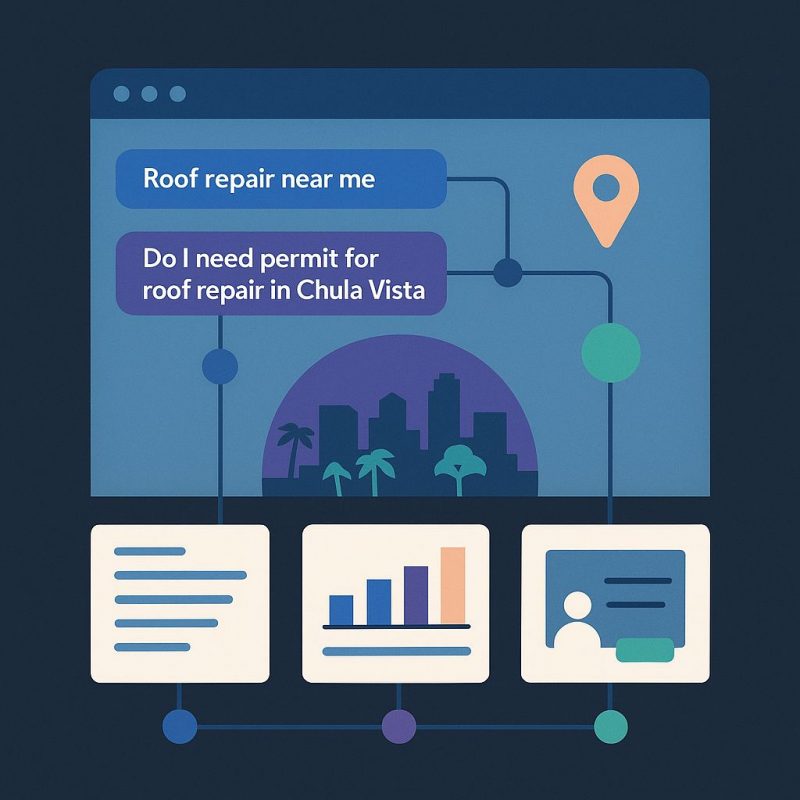
Page one ranking, steady traffic, flat conversions. A San Diego dentist’s service page holds position one for “dental implants San Diego,” and the phone is not ringing proportionally. When we audit the page, the reason is visible in the search data: that single keyword is actually three different searches compressed into two words. One user wants to know what dental implants cost. Another wants to compare providers. A third is ready to book. The page answers only the third user and ignores the first two. The traffic arrives, finds nothing useful, and leaves.
The broader intent-mismatch problem is covered in our intent-mismatch resolution framework for local service businesses and in crafting content for user intent, not just algorithms. This piece addresses the San Diego-specific layer: how neighborhood-tier fragmentation across a metro area compresses multiple intent stages into the same query, and how a single service page can absorb all of them without splitting into thin location pages. In practical terms: when three different people type the same search phrase but need three different things from the result, the page has to serve all three or lose two of them.
Why Single-Intent Pages Fail in Neighborhood-Fragmented Markets
Think With Google data documents local intent as a dominant share of mobile search behavior, with “near me” queries rising year over year and mobile users often converting within 24 hours of a local search. Conversion rates on local-intent keywords consistently outperform general search terms across service categories including home services, legal, medical, and professional trades. Local searchers are high-intent, action-oriented, and impatient. They are also not uniform.
A single query like “solar installation San Diego” fragments into at least three intent layers. One user wants to understand cost and ROI (informational). Another wants to compare contractors and read reviews (commercial investigation). A third wants to schedule an estimate today (transactional). These three users may type the same words. They need different content. A page that serves only the transactional user abandons the other two to competitors.
In San Diego specifically, this fragmentation compounds because of neighborhood-tier variance in search behavior. Search patterns in coastal communities like La Jolla and Del Mar skew toward credentialing, design portfolio, and due diligence. Searches in more price-sensitive neighborhoods like City Heights or Chula Vista index more heavily on cost transparency and bilingual accessibility. Searches from commercial districts carry compressed decision timelines. A single generic service page cannot absorb all of these signals simultaneously, but a multi-intent page architecture can.
This neighborhood-tier dynamic is specific to metros with sharp geographic income and lifestyle stratification. For deeper context on how San Diego’s hyperlocal patterns differ from broader local SEO conventions, see our hyperlocal systems playbook for San Diego.
How Multi-Intent Page Architecture Works
The concept is structurally simple: one URL, multiple content modules, each serving a different stage of the decision process. The execution is where most pages fail.
| Module | Stage | Content | CTA |
|---|---|---|---|
| Informational | Early research | FAQs, cost context, explainers | None or soft |
| Comparative | Evaluating options | Data tables, comparisons, pricing | Earn trust |
| Conversion | Ready to act | Forms, click-to-call, scheduling | After proof |
Informational modules sit early in the scroll. A potential customer researching solar panels does not want a quote form as the first thing they see. They want to understand what solar costs in their area, what incentives are available, and whether the technology fits their situation. Collapsible FAQ sections and contextual explainers address these questions without pushing the user toward a decision they are not ready to make.
Comparative modules sit in the middle. Once the visitor understands the basics, they start comparing options. Data tables, side-by-side service comparisons, and transparent pricing frameworks serve this stage. The goal here is earned trust, not urgency. A visitor comparing three contractors will spend time on the page that gives them the clearest comparison. The others get closed.
Conversion modules sit where intent demands them. Forms, click-to-call, and scheduling tools belong after proof, not before it. A CTA placed after a case study or a pricing breakdown converts better than one placed above the fold on a page the visitor has not yet decided to trust. A homepage with four competing CTAs splits visitor attention across actions the visitor did not come to evaluate. In the pages we restructure around a single primary action, form completion rates consistently improve over the multi-CTA versions they replace. One primary conversion path, reinforced consistently, outperforms scattered options.
The structural principle: each content block maps to a different intent stage for the same service keyword. The visitor scrolls through the page and encounters the content they need at the moment they need it. They do not have to click to another URL and restart their evaluation. The decision process stays on one page because the page was built to contain it.
If this architecture sounds like what your San Diego service pages are missing, start with an audit that maps which intent stages your current pages leave unserved.
Neighborhood Intent Mapping: Why Geography Changes Content Strategy
In San Diego, geography doubles as an intent signal, not only a location marker.
Take home renovation. In a coastal neighborhood where property values are high, the homeowner searching “kitchen remodel” is evaluating design portfolios, reading case studies, and checking certifications before contacting anyone. The service page that leads with credentials, visual proof, and project timelines captures this user. The one that leads with a price calculator loses them.
In a neighborhood where price sensitivity is higher, the same “kitchen remodel” query carries a different expectation. The user wants cost ranges, payment plan information, and transparent scope descriptions before they engage. The page that leads with “request a custom quote” without providing any cost context creates friction. The user leaves for a competitor that shows what things actually cost.
For professional services, the pattern shifts again. A search for “personal injury lawyer” in a business district carries urgency and specificity (accident type, jurisdiction, timeline). The same search in a residential area may be more exploratory (do I have a case, how does this work, what does it cost). One page can serve both users, but only if it is structured to answer both sets of questions.
At Southern Digital Consulting, we build service pages that recognize these geographic intent differences and modulate content accordingly. A single URL can carry neighborhood-specific proof elements (project photos, permit references, local testimonials), intent-appropriate content ordering, and CTA placement calibrated to where the user is in their decision process. The page does not guess which user arrived. It provides content for all of them. This layered approach aligns with the broader semantic principle that search context outweighs keyword matching.
The Technical Layer: Schema and Internal Linking That Make Multi-Intent Pages Work
A multi-intent page without the right technical infrastructure is a content dump. Schema and internal linking are what make the architecture legible to search engines and, increasingly, to AI search systems.
FAQ schema converts informational content into featured snippet eligibility. The questions must come from real search query data, not assumptions. “How much does solar installation cost in San Diego?” outperforms “What is solar energy?” because the first is a real query with search volume and the second is a textbook definition nobody searches for.
Service schema anchors the primary commercial offer. Nested markup for service variants, geographic areas, and pricing tiers enables search engines to surface the right SERP features for the right queries. This is particularly valuable as AI Overviews expand: Pew Research Center behavioral data (2025) found that click-through rates drop from 15% to 8% when an AI Overview appears, making structured data that earns citation placement a direct competitive advantage. Structured data helps AI systems identify which businesses to cite when those searches occur.
Hub-and-spoke internal linking connects blog content to specific page sections. A blog post about “solar panel ROI in La Mesa” should not link generically to the solar service page. It should deep-link to the pricing or FAQ section of that page, matching the blog reader’s intent to the specific content module that continues their journey. This reduces bounce, increases time on page, and signals topical depth to search engines.
In-page anchor linking between related modules keeps the visitor moving. A user reading about permits likely cares about timelines and costs. Anchoring those adjacent questions within the same page builds session depth while eliminating the dead-end problem that kills single-intent pages.
What We See When Multi-Intent Pages Are Missing
The pattern is consistent across the San Diego audits we run. A business ranks for its primary keyword. Traffic arrives. The conversion rate on these pages typically sits between one and two percent, sometimes lower. The traffic is real, but the page answers only one version of the user’s question.
When we restructure these pages into multi-intent architecture, the change is measurable in the metrics that matter. Scroll depth increases because users find content relevant to their specific stage. Form completions rise because the CTA appears after proof, not before it. Bounce rate drops because informational visitors are no longer landing on a transactional page that has nothing for them.
Isolated pages compete alone. Clustered content, arranged around the same service keyword across multiple intent stages, competes as a system. The businesses in San Diego holding their SERP position through algorithm updates and AI expansion are the ones with pages built to absorb multiple intent signals rather than optimizing for a single keyword in isolation.
If your San Diego service pages are generating traffic without proportional conversions, the intent architecture is usually where the gap lives. Southern Digital Consulting’s San Diego SEO services include multi-intent page audits as part of every engagement. Map the queries your page ranks for, identify the intent stages that go unserved, and design the content modules that close the gap. Start with a free consultation.
FAQ
How do I know if my service page has a multi-intent problem? The gap shows up in Search Console data. If the queries driving traffic to a page span informational, commercial, and transactional intent but the page content addresses only one type, visitors are arriving and finding nothing relevant to their stage. High traffic with low conversion on a single URL is the clearest signal.
Should I create separate pages for different neighborhoods? Only when the search behavior and conversion path differ entirely between neighborhoods. If user flow overlaps (same service, similar questions, different geographic context), keep it on one page with modular neighborhood proof elements rather than splitting into thin location pages that dilute topical authority.
How does multi-intent architecture work with AI search? AI systems pull from pages that answer specific questions with structured, evidence-backed content. A multi-intent page with FAQ schema, clear section headers, and direct answers to real queries gives AI systems more extractable content than a single-purpose landing page. This increases citation probability across Google AI Overviews, ChatGPT, and Perplexity.
What metrics prove a multi-intent page is working? Scroll depth by section, form completion rate compared to traffic volume, bounce rate segmented by query intent, and SERP coverage across different keyword types for the same URL. If the page ranks for informational and transactional queries simultaneously and converts from both, the architecture is working.
About the Author This article was produced by the SEO and content strategy team at Southern Digital Consulting, under the direction of Co-Founder Nick Rizkalla. SDC serves businesses across San Diego, Atlanta, Macon, and nationally, with over 25 years of experience in search visibility, web design, and conversion-focused page architecture for local and multi-location service businesses.