
By Nick Rizkalla, Co-Founder, Southern Digital Consulting (Macon, GA). 14 years in marketing and digital strategy. Last reviewed: April 26, 2026.
Note on schema examples below: Sample values such as “[Attorney full name]” and “[Firm legal name]” are placeholders. Replace every value with the firm’s actual data before publishing. Sample data left in production schema creates misleading entity signals and can trigger schema spam flags in Google’s quality systems.
The Bio Problem: Why Most Attorney Pages Get Zero Organic Traffic
Open Google Search Console for any attorney bio page on a firm’s site. Filter by URL. Pull the last 90 days. If the firm’s marketing lead handles this, hand them the URL filter step and the impressions report. If a partner is reading directly, the same data sits in any monthly SEO report from the firm’s vendor. This article is structured as a reference, with a schema block and a Georgia RPC table that some readers will return to. Across the SDC portfolio of Georgia personal injury firms, the same pattern repeats: bio pages return single-digit impressions and zero clicks.
That outcome is not random. Bio pages run on a standard template (photo, education, bar admissions, two paragraphs about advocacy, contact button), and the template gives Google nothing to rank. A Google search for “personal injury attorney Macon” returns ten firms, each with a bio page that reads like every other bio page on the SERP. Disambiguation fails. The page sinks.
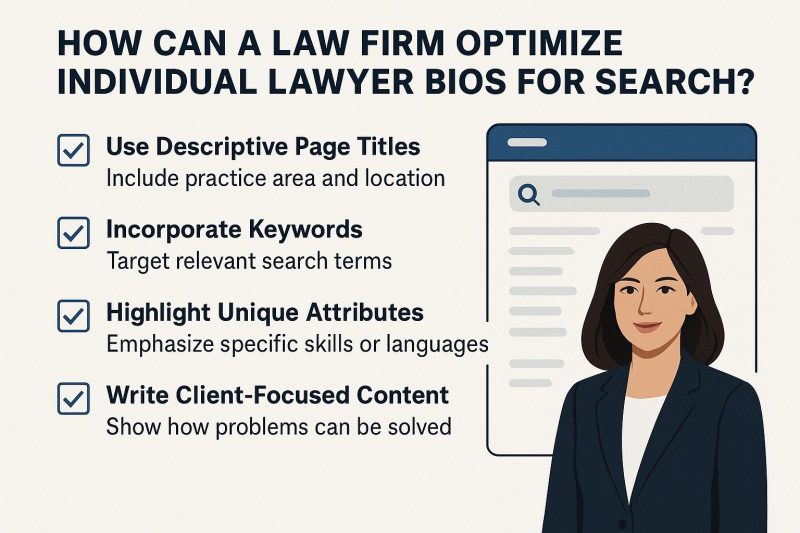
Three patterns drive the invisibility:
- Generic adjective stacking (“aggressive advocate”, “dedicated counsel”, “experienced trial attorney”)
- Missing entity signals (no court admissions, no language data, no association memberships in structured form)
- Orphan page architecture (bio pages with no inbound internal links from practice area, blog, or location pages)
Each pattern is fixable. None of them get fixed by adding more adjectives.
What Changed in 2026: Google’s Authors Documentation Update
On February 1, 2026, Google added a dedicated Authors section to Search Central documentation, which formalized authorship transparency as a quality signal. Before that update, author markup was implicit best practice. After the update, it became a documented expectation.
What the change means for law firms in 2026:
| Element | Before Feb 2026 | After Feb 2026 |
|---|---|---|
| Author byline | Recommended | Documented expectation |
| About-the-author block | Optional | Practical requirement |
| Linked author profile | Helpful | Direct quality signal |
| Authored articles linked back to the bio | Helpful | Compounding authority loop |
Google now expects a clear chain: the article shows an author, the author has a profile, the profile shows credentials and authored content, and that content links back to the profile. Bio pages that sit in isolation cannot complete that chain.
We rebuilt three attorney bios for a Macon firm over Q1 2026, with linked authored content and the schema pattern below. Our team is tracking 90-day results across all three. Two showed early movement on long-tail “[city] [practice area] attorney” queries within 60 days. Search Console screenshots and ranking history are on file with the client firm. The three pilots are part of SDC’s broader work with personal injury firms across Georgia. We currently support nine personal injury practices in the state, with bio audits running on a quarterly cadence. We are not calling the pattern proof on three pilots. We are reporting what the documentation predicted, with sample size disclosed.
The Diagnostic Step: Three Questions Before Any Rewriting Starts
A bio rewrite without a diagnosis produces a new template that fails the same way as the old template.
Three questions to answer first, with data:
- Which queries does this attorney’s name return in Search Console? (If the answer is “none”, the disambiguation problem sits upstream of the bio.)
- Does the bio page have inbound internal links from practice area pages, blog posts, and location pages? (A site search or a Screaming Frog crawl will surface the count in under an hour.)
- Is the attorney named in authored content elsewhere on the site, and does that content link to the bio? (If not, the authority loop is broken before the rewrite begins.)
The three answers tell a firm which problem is dominant: a bio rewrite, an internal linking project, or a content authorship buildout. The work is different in each case, but the entry point is the same. Whichever answer comes back first, the pilot starts with one attorney, one practice area, one rewrite. The “Practical Starting Point” section at the end of this article walks through that pilot.
Decision snapshot: If question 1 returns no impressions, fix the bio first. If question 1 returns impressions but no clicks, fix the title and meta description before the bio body. If questions 2 and 3 both return zero, the problem is internal linking and authored content, not the bio itself.
Schema That Actually Works in 2026 (Attorney Type Is Deprecated)
The schema.org Attorney type is deprecated. Firms still using Attorney in their structured data are using a marker Google has signaled away from. The 2026 best practice combines Person (the individual attorney), LegalService (the firm), and Organization (the parent entity), connected through explicit relationships.
A working pattern, with placeholder values to replace:
{
  "@context": "https://schema.org",
  "@type": "Person",
  "name": "[Attorney full name]",
  "jobTitle": "[Specific title, e.g. 'Senior Trial Attorney']",
  "worksFor": {
    "@type": "LegalService",
    "name": "[Firm legal name]",
    "address": {
      "@type": "PostalAddress",
      "addressLocality": "Macon",
      "addressRegion": "GA"
    }
  },
  "alumniOf": {
    "@type": "CollegeOrUniversity",
    "name": "[Law school full name]"
  },
  "knowsLanguage": ["en", "es"],
  "memberOf": {
    "@type": "Organization",
    "name": "State Bar of Georgia"
  },
  "areaOfExpertise": ["Personal Injury Law", "Wrongful Death"],
  "url": "[full URL of the bio page]"
}
Second placeholder reminder, after the schema block: Before the schema goes into a CMS, search the file for
[and confirm zero remaining bracketed values. In SDC’s audits, bracket-strings left in production are a frequent cause of broken schema deployments. Strip every bracket value before the schema ships.
Two technical notes that matter:
- The
knowsLanguagefield follows IETF BCP 47 codes (“en”, “es”, “zh-Hans”). Free-text language names (“English”, “Spanish”) will not validate. Personschema gains weight when it is referenced from related schemas (the firm’sLegalServiceschema lists the attorneys, the attorney’s authored articles useArticleschema withauthorreferencing the samePerson).
Validation through Google’s Rich Results Test before publishing prevents sample data from leaking into production. Bad entity signals take months to clean.
Entity Stacking: The Specifics That Make Bios Findable
Google recognizes entities. “Aggressive advocate” is not an entity. “Member of the Macon Bar Association, admitted to the Middle District of Georgia, fluent in Spanish” is three entities in one sentence.
Specific elements that function as entities for attorney bios:
- Bar admission numbers and dates (verifiable, structured)
- Court admissions (Bibb County Superior Court, Houston County State Court, Northern District of Georgia, Eleventh Circuit)
- Bar association memberships (State Bar of Georgia, Macon Bar Association, Georgia Trial Lawyers Association)
- Law school name and graduation year
- Languages, listed with BCP 47 codes in schema and plain text in body copy
- Practice area subspecialties at the granularity clients actually search
The subspecialty point matters. “Personal injury” is too broad to win a Macon SERP. “Tractor-trailer accident attorney for I-75 corridor cases” is narrow enough to rank, and it matches how clients in Macon and Warner Robins describe their problem when they search.
Decision snapshot: List every court each attorney has appeared in over the last 18 months. The list becomes part of the entity stack on each bio page. If an attorney has appeared in fewer than three distinct courts, the entity stack is thin and the bio strategy depends more on subspecialty depth.
Local Authority for Georgia Firms: Bibb, Fulton, and Beyond
National SEO tactics do not transfer to law firm bio pages. People searching for an attorney search locally, with neighborhood and landmark cues in the query string.
Georgia-specific anchors that show up in real client queries include county names (Bibb, Houston, Fulton, DeKalb, Cobb, Gwinnett), specific courts (Bibb County Superior Court, Atlanta Municipal Court, Northern District of Georgia), hospitals near firm offices (Atrium Health Navicent in Macon, Piedmont and Emory in Atlanta), highway corridors clients name in injury cases (I-75, I-475, I-285), and neighborhood markers (downtown Macon, Vineville, Buckhead, Midtown).
These anchors do two things at once. They match how clients phrase searches, and they signal to Google that the attorney’s geographic relevance is concrete rather than generic. A bio page that mentions one Georgia city in passing competes with every other bio page that mentions one city in passing. A bio page that names six county-level entities, three courts the attorney regularly appears in, and two specific hospital systems competes in a much narrower set.
The work to build that stack is straightforward but not optional. The firm pulls the attorney’s docket history for the last 18 months, lists the courts and counties that show up most often, and notes the hospital systems that appear in injury case files. When truck accident work is part of the practice, the I-corridor names go in the same column. None of this requires creative writing. It requires the firm to look at its own case data and surface what is already there.
Decision snapshot: Before rewriting any bio, whoever runs the firm’s case files (a paralegal, a marketing lead, or the attorney) pulls 18 months of docket history and writes one column for courts, one for counties, one for hospital systems. The column with the most entries becomes the spine of the bio’s local authority section.
Bar Compliance: What Georgia RPC 7.1, 7.3, 7.4 Allow on Bio Pages
Bio page content is regulated. The Georgia Rules of Professional Conduct sit on top of every claim a firm publishes about its attorneys. Three rules drive most of the constraints:
- Rule 7.1 prohibits false or misleading communications about the lawyer or the lawyer’s services. Comparative claims (“the best DUI attorney in Macon”) trigger this rule unless they are factually verifiable and not subject to reasonable dispute.
- Rule 7.3 governs solicitation and limits direct contact patterns. Bio page CTAs that promise specific outcomes drift into 7.3 territory.
- Rule 7.4 covers fields of practice. Calling an attorney a “specialist” or “expert” requires that the attorney is certified by an organization approved under Rule 7.4.
Practical bio page constraints that follow from these rules:
| Pattern | Risk under Georgia RPC |
|---|---|
| “Best [practice area] attorney in [city]” | 7.1 misleading communication |
| “Specialist in [field]” without 7.4 certification | 7.4 prohibited designation |
| “Recovered $X for similar clients” with no disclaimer | 7.1 past results without context |
| “We will win your case” or “guaranteed outcome” | 7.1 misleading + 7.3 solicitation |
| Client testimonials and endorsements without the State Bar disclaimer | 7.1 misleading communication + Rule 7.2 advertising disclosure requirements |
| Verifiable case-type counts (“handled 200+ DUI cases in Bibb County”) | Generally permitted, requires accuracy |
Past results disclaimers are the practical workaround for case examples. The State Bar of Georgia publishes the disclaimer language standards in its lawyer advertising materials. Generic disclaimers that do not match the case being discussed do not provide compliance protection. Per the State Bar of Georgia’s advertising rules and the comments to Rule 7.1, testimonial disclaimers reference that past results do not predict future outcomes, and they sit visually adjacent to the testimonial rather than in a footer.
This article is informational and addresses SEO content strategy. It is not legal advice. Verify any compliance interpretation with the firm’s general counsel or an ethics attorney before publishing claims about attorney experience or outcomes.
Internal Linking: Stop Orphaning Attorney Pages
Firms publish bio pages and then never link to them again. The bio sits in the team page directory, technically findable, practically isolated. Google reads that isolation as low importance.
Internal links that move ranking weight to attorney bio pages:
- Practice area pages link to the attorneys who handle that practice area, by name, in body copy
- Blog posts authored by an attorney show a byline that links to the full bio
- Case result pages name the lead attorney and link to the bio
- Location pages list the attorneys who work from that office
- FAQ pages reference attorneys when the question requires a named author
Each link is a small vote. The aggregate is what Search Central documentation describes as the authorship chain.
For SDC clients on the SEO for law firms program, the local SEO services, or SEO services in Atlanta, internal linking audits run quarterly. Firms outside the SDC portfolio can run a manual crawl with a tool like Screaming Frog or Sitebulb to surface orphan bio pages in a single afternoon.
Decision snapshot: Run a Screaming Frog crawl on the firm’s full site. Filter for bio page URLs. Sort by inbound internal link count. Any bio with fewer than five inbound internal links is functionally orphaned. That list is the first month’s internal linking project.
Measurement: What to Track in 60-90 Days
Bio page work is slow to pay off. Setting realistic measurement windows is part of the job.
What to track per attorney bio page includes organic impressions and clicks in Search Console (filter by bio URL), keywords ranking in the top 50 for “[attorney name] [practice area]” and related branded queries, inbound internal links (counted from a crawler, not estimated), time on page for sessions that land on the bio (engagement signal, not a ranking factor on its own), and contact form submissions and phone calls attributed to bio page sessions.
Realistic timelines:
- 30 days: technical changes (schema, internal links, URL structure) indexed
- 60 days: keyword movement on long-tail “[attorney name] + [city]” queries
- 90 days: engagement metrics (time on page, scroll depth) visible at the page level
- 120-180 days: contact form attribution to bio pages stabilizes
Firms that expect ranking gains in two weeks abandon the work before it pays. Firms that wait six months without checking abandon the work for a different reason. The 30-60-90 cadence is the working middle.
Practical Starting Point: One Attorney This Quarter
A full bio overhaul across a 12-attorney firm is a quarter-long project. A firm of that size rarely has the bandwidth to start there.
A workable first step looks like this:
- Pick the attorney who handles the firm’s highest-margin practice area
- Pull that bio page’s Search Console data, current schema, and inbound internal link count
- Rewrite the bio to remove generic adjectives, add the entity stack (court admissions, languages, associations, subspecialties), and update schema to the 2026 Person + LegalService pattern
- Add three internal links to the bio from practice area, blog, and location pages
- Schedule the 60-day re-check on the calendar before the rewrite ships
That single-attorney pilot creates the data point a firm needs before committing to the full overhaul. If 60-day organic impressions move and keyword rankings shift, the pilot validates the approach and the rest of the firm’s bios follow the same pattern. If the metrics do not move, the diagnostic step (three questions earlier in this article) returns more useful answers than a full template rebuild would have.
The first attorney bio is the cheapest experiment a firm can run this quarter. It costs less than a single failed PPC campaign, and the results compound for as long as the attorney stays at the firm.
Run the single-attorney pilot with us. SDC scopes one attorney bio for a Georgia firm: a current-state audit, a schema rewrite, an entity stack, an internal link map, and a 60-day measurement plan tracked through Search Console. The pilot gives the firm a concrete data point on one bio before the firm commits to a wider engagement. Email contact@southerndigitalconsulting.com or call (478) 200-2604 to scope the engagement.
Nick Rizkalla is co-founder of Southern Digital Consulting in Macon, Georgia. SDC builds SEO programs for law firms across Georgia, with nine active personal injury firm engagements as of Q1 2026 in markets including Macon, Atlanta, Columbus, Savannah, and Warner Robins. For a structured bio audit on the firm’s attorney pages, the Atlanta SEO services and local SEO services program pages outline engagement steps. Contact: contact@southerndigitalconsulting.com or (478) 200-2604.
Last reviewed: April 26, 2026.