
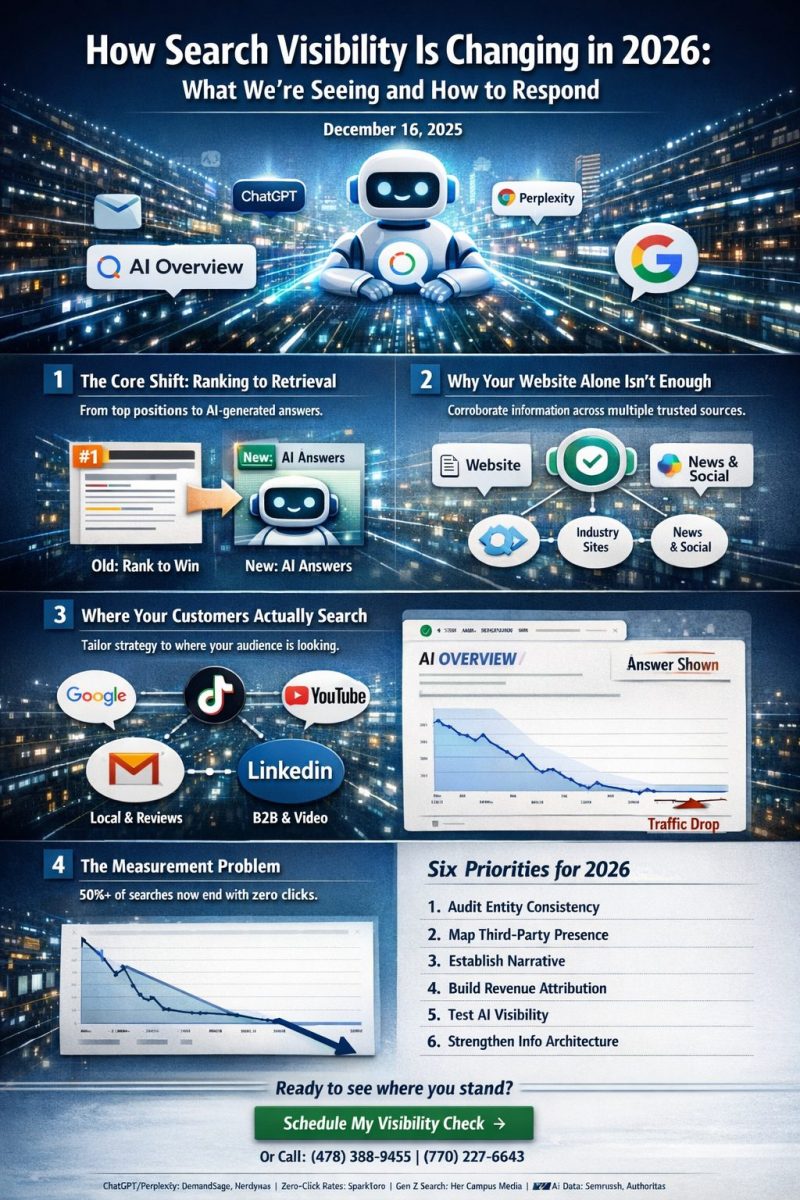
Over the past year, we’ve had more conversations with clients about AI search than in the previous five combined. Business owners in Macon, Atlanta, and across our national client base are noticing shifts: traffic patterns changing, new competitors appearing, questions about ChatGPT and “AI Overviews.”
These changes are real. The businesses adapting early are gaining ground. Here’s what the data shows and how we’re helping clients respond.
The Core Shift: Ranking to Retrieval
Traditional search ranked pages against each other. Best content won a position. Simple.
AI-powered search works differently. ChatGPT, Perplexity, and Google’s AI Overviews pull information from multiple sources, synthesize answers, and present results. Your content either gets included or it doesn’t.
The scale: ChatGPT reached 800 million weekly active users by September 2025. Perplexity hit 129.5 million monthly visits. These are primary information sources now, not experiments.
For businesses, visibility now depends on two things: traditional ranking performance AND being recognized by systems generating AI answers. Both matter. The balance is shifting.
Does your business show up in AI answers? We’ll check your visibility across ChatGPT, Perplexity, and Google AI Overviews for your key terms. Takes 15 minutes. No cost.
Why Your Website Alone Isn’t Enough
AI systems prioritize information confirmed by multiple trusted sources.
A claim on your website alone is treated as a claim. The same information appearing across your site, industry publications, and professional directories gets treated as verified fact.
Authoritas research confirms this “Corroborated Digital Entities” principle. Information validated across YouTube, LinkedIn, and authoritative news sites carries more weight than single-source claims.
What this means practically:
For a law firm, being mentioned in legal publications and professional directories reinforces what your website says. For a service business, reviews across Google, Yelp, and industry platforms create the consensus AI systems look for.
Your website remains the hub. But it works best when supported by consistent presence across trusted sources.
Entity Clarity: Making Sure Machines Understand You
Search systems think in entities, not keywords. An entity is your business as a defined thing: brand, services, location, credentials.
Sites with proper schema markup and consistent entity information show stronger visibility in AI Overviews. And 91% of queries triggering AI Overviews are informational—exactly where entity clarity matters most.
Important caveat: Schema markup alone doesn’t create visibility. It helps machines understand what’s already clear. If your brand messaging is fragmented, schema just communicates that fragmentation more efficiently.
The real work is alignment: how you describe your business on your website, Google Business Profile, LinkedIn, and industry directories. When descriptions conflict across platforms, AI systems struggle to categorize you accurately.
Where Your Customers Actually Search
Search behavior is fragmenting. 74% of Gen Z uses TikTok as a search engine. 51% prefer it over Google for discovery. YouTube remains the second-largest search engine. Reddit content increasingly appears in AI answers.
Google still dominates at 80%+ market share. But the smartest strategies account for where specific customers look.
Quick decision framework:
- Short sales cycle, local service: Google Maps + reviews + landing pages
- Expertise-based business: YouTube + LinkedIn + industry publications
- Younger audience: TikTok + Instagram + UGC + reviews
Platform selection matters more than platform presence. We help clients identify where their actual customers search—that determines where investment goes.
Where are your customers actually finding you? We’ll map your visibility across the 5 platforms that matter most for your industry. Specific gaps. Specific priorities.
The Measurement Problem You Need to Understand
According to SparkToro, over half of US searches end without a click. When AI Overviews appear, organic clicks drop 15-30%.
This creates a business problem. A customer might see your business in an AI answer, develop awareness, and convert later through a direct search or phone call. Traditional analytics miss this entirely.
The organizational risk: If your SEO reporting only tracks traffic, and traffic declines while business stays steady, it looks like SEO stopped working. We’ve seen companies cut SEO budgets based on this misread, then watch competitors take the visibility they abandoned.
Traffic alone no longer tells the full story. Revenue attribution does.
The Most Overlooked Factor: Context Over Frequency
Being mentioned everywhere matters less than being mentioned correctly somewhere.
A CRM company mentioned generically alongside ten competitors gains little. The same company positioned as “best CRM for manufacturing businesses with complex inventory” gains a defensible position.
A personal injury lawyer described as “Atlanta attorney” competes with thousands. The same lawyer positioned as “Amazon delivery truck accident attorney in Atlanta” owns a specific category.
Retrieval systems aren’t just deciding whether to mention you. They’re deciding how to describe you. If you don’t define that positioning, AI systems will categorize you randomly.
What to Stop Doing
Stop: Measuring SEO success purely by traffic volume Instead: Connect visibility metrics to revenue outcomes
Stop: Treating your website as your entire online presence Instead: Build consistent presence across platforms AI systems reference
Stop: Publishing monthly blog posts chasing “informational traffic” Instead: 10 high-intent service pages + 20 scenario-specific pages + 1 authority asset
Stop: “We did schema, we’re done” Instead: Entity narrative + third-party corroboration + schema together
Six Priorities for 2026
1. Audit entity consistency. Check how your business appears across Google Business Profile, LinkedIn, directories, and your website. Fix every inconsistency.
2. Map third-party presence. Identify authoritative sources where you should appear but don’t. Build a plan for earning presence through expertise or industry participation.
3. Establish narrative control. Define your one-sentence positioning. Make sure it appears consistently everywhere.
4. Build revenue attribution. Supplement traffic metrics with post-purchase surveys, brand search tracking, and cohort analysis.
5. Test multi-surface visibility. Check whether you appear in ChatGPT, Perplexity, and AI Overviews for relevant queries.
6. Strengthen information architecture. Clean structured data and well-organized content make you easier for any system to understand.
What This Means for Your Business
Search is evolving. The businesses that understand how discovery works now have real advantage over those optimizing for yesterday’s model.
Through every major shift in search—algorithm updates, mobile-first indexing, local pack changes—the fundamentals have stayed consistent: genuine authority, technical excellence, consistent presence. This shift is significant, but those fundamentals still apply. What’s changing is how authority gets recognized across new surfaces.
The businesses that adapt will maintain visibility as the landscape fragments. Those that don’t will watch traffic decline and wonder why rankings didn’t protect them.
Ready to see where you stand?
In one call, we’ll show you:
- Whether you appear in AI answers for your key terms
- Where your entity information conflicts across platforms
- Which 3 platforms matter most for your specific business
30 minutes. Specific findings. No fluff.
[Schedule My Visibility Check →]
Or call: (478) 388-9455 (Macon) | (770) 727-6643 (Atlanta)
Sources
- ChatGPT/Perplexity usage: DemandSage, Nerdynav (September 2025)
- Zero-click rates: SparkToro
- AI Overview data: Semrush “State of Search 2025”
- Gen Z search behavior: Her Campus Media Survey (March 2025)
- Entity patterns: Authoritas “The Perfect Click” Study (2025)