
You built a landing page. It converts at 4% from Google Ads. Natural next thought: why not rank it organically too?
Three months later, it ranks nowhere. Or worse, it ranks but organic visitors bounce at 80% while paid traffic still converts fine.
The page did not break. You asked it to serve two algorithms with opposing reward functions.
Every SEO agency will tell you “PPC pages are short, SEO pages are long.” That is surface-level. The real divergence runs deeper: crawl behavior, attribution systems, quality score mechanics, and index management. Miss these and you will build pages that underperform in both channels while cannibalizing your own budget.
What Is the Difference Between SEO and PPC Landing Pages?
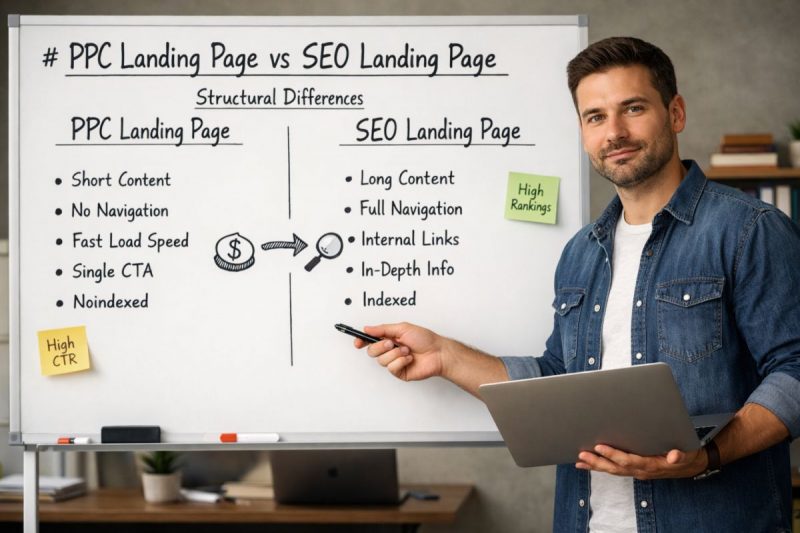
SEO landing pages are designed to rank in organic search results through comprehensive content, proper site navigation, and topical authority signals. PPC landing pages are designed to convert paid traffic through focused messaging, minimal distractions, and aggressive conversion optimization. The same page cannot maximize both because the algorithms reward opposite behaviors.
Why the Algorithms Want Opposite Things
Google Ads and Google Search share infrastructure. They do not share objectives.
Google Ads optimizes for auction health. The quality score system evaluates three components: expected click-through rate, ad relevance, and landing page experience. That landing page experience score factors mobile usability, load speed, content relevance to the ad, and ease of navigation. Google profits when users click ads, find what the ad promised, and complete a transaction. Every element of quality score serves this loop.
Google Search optimizes for query satisfaction across the entire index. The helpful content system rewards comprehensive coverage, demonstrated expertise, and topical authority. Google profits when users find answers and stop searching. Depth, context, and thoroughness signal quality.
Here is the tension: depth creates friction. Friction kills conversions. The same page cannot maximize both.
The Navigation Paradox
This is where hybrid attempts die.
SEO pages require navigation. Googlebot discovers pages through internal links. A landing page with stripped navigation looks isolated. Isolated pages signal thin content or doorway page tactics. Header links, footer links, breadcrumbs, and contextual internal links all contribute to crawlability and topical authority signals.
PPC pages convert better without navigation. Conversion rate optimization research consistently shows that removing exit paths increases completion rates. Every link that is not your CTA represents a leak. Top-performing PPC pages strip headers, hide footers, and eliminate any click target except the conversion action.
You cannot satisfy both requirements with one page. Keep navigation and watch PPC conversion drop. Remove it and watch organic rankings stagnate or trigger quality flags.
Crawl Budget and Index Bloat
Nobody talks about this. They should.
When you create PPC landing pages and leave them indexable, three things happen:
First, crawl budget dilution. Google allocates finite crawl resources per domain. Every PPC variant you create consumes crawl budget that could go to pages you actually want ranked. If you are running 50 ad groups with dedicated landing pages, that is 50 pages competing for crawl attention.
Second, index quality signals. Google evaluates your domain partly on average page quality. PPC pages optimized for conversion are often thin by SEO standards. A site with 200 content pages and 150 thin PPC pages sends mixed quality signals.
Third, duplicate content risk. PPC pages targeting similar keywords with slightly different headlines create near-duplicate clusters. Google consolidates these unpredictably. You lose control of which version surfaces.
The fix is architectural: PPC pages live in a noindexed subdirectory (/lp/ or /ppc/), blocked from crawl via robots.txt, or served on a separate subdomain excluded from search.
Quality Score Decay Loop
Here is a failure mode nobody explains mechanically.
You have a PPC page converting at 5%. Quality score is 8/10. Someone decides to add 1,500 words of SEO content to capture organic traffic too.
What happens to quality score:
Landing page experience drops. The quality score algorithm evaluates how quickly users find what the ad promised. More content means more scrolling. More scrolling means delayed engagement signals. The page “matches” the ad less tightly because the conversion path is now buried.
Expected CTR stays flat or drops. If your organic content starts ranking, some users will click the organic result instead of the ad. Your ad impression-to-click ratio weakens.
Relevance score may drop. Comprehensive SEO content covers adjacent topics. If your ad targets “project management software pricing” but your page now discusses implementation timelines, integrations, and competitor comparisons, the semantic match loosens.
Net result: quality score drops from 8 to 6. CPC increases significantly. Your “free organic traffic” just made your paid traffic more expensive.
Attribution Contamination
Single page, two channels, one conversion. Who gets credit?
Standard attribution models cannot cleanly separate this. A user might:
- See your ad, not click
- Search again, click organic result
- Browse, leave
- Return direct, convert
Last-click attribution credits direct. First-click credits organic. Linear gives partial credit to both. None of them tell you whether the ad or the organic listing drove the decision.
This matters for budget allocation. If you cannot measure channel contribution accurately, you cannot optimize spend. Separate pages with separate URLs create clean attribution. Same page with UTM parameters still leaves ambiguity when users convert on return visits without parameters.
SERP Cannibalization Economics
You rank position 3 organically for a keyword. You also bid on that keyword. Your ad shows position 1.
Question: are you capturing incremental clicks or paying for clicks you would have gotten free?
Research on this varies by brand strength and keyword type, but the pattern holds: bidding on keywords where you already rank organically has diminishing returns. You pay for some percentage of clicks that would have come through organic anyway.
With separate pages, you can test this cleanly. Pause ads, measure organic CTR change. Calculate incrementality. With a single page, the signals blur.
The strategic play: use PPC pages for keywords where you do not rank organically. Use SEO pages to reduce paid dependency over time. Separate architectures enable this transition.
PPC vs SEO Landing Page: Side by Side Comparison
| Element | SEO Landing Page | PPC Landing Page |
|---|---|---|
| Primary goal | Organic ranking and sustained traffic | Immediate conversion from paid clicks |
| Word count | 1,000-2,500+ depending on competition | 200-500 focused on conversion |
| Navigation | Required (header, footer, breadcrumbs) | Often removed entirely |
| Internal links | Multiple, contextual | Minimal or none |
| H2/H3 structure | Comprehensive topic coverage | Single benefit hierarchy |
| Above-fold content | May include table of contents | CTA visible immediately |
| Page speed priority | Important but secondary to depth | Critical, every millisecond matters |
| Index status | Indexed, canonical set | Noindexed or excluded |
| URL structure | Semantic, keyword-rich | Tracking parameters acceptable |
| Testing velocity | Slow (ranking stability needed) | Fast (no SEO constraints) |
| Content updates | Careful (rankings can reset) | Continuous (no penalty) |
| Keyword targeting | Broad, long-tail, informational | Specific, transactional, high-intent |
| Trust signals | Authority content, expertise demonstration | Testimonials, urgency triggers, social proof |
When Can One Page Serve Both Channels?
Hybrid pages succeed under narrow conditions:
Branded searches. Someone searching your company name already has intent aligned with conversion. Your homepage or product pages can serve both channels because the query itself filters for high-intent users.
Bottom-funnel commercial queries. “Buy [product]” or “[product] pricing” searches indicate readiness to transact. The SEO-required depth may align with conversion needs because users want details before purchasing anyway.
Low-competition verticals. In industries where competitors publish little content, a conversion-focused page might rank simply due to scarcity. This is rare and getting rarer.
Outside these cases, structural requirements diverge too much for a single page to optimize both.
Decision Framework: When to Separate vs. Combine
Separate pages when:
- Keyword has commercial intent but requires educational content to rank
- You need aggressive conversion testing without SEO risk
- Attribution clarity matters for budget decisions
- You are running multiple ad variants against similar keywords
- Your PPC pages would dilute site quality signals
Consider hybrid when:
- Query is branded
- Search intent is purely transactional
- Competitor content is thin
- Page already ranks and converts acceptably in both channels
Never hybrid when:
- You need to test headlines, CTAs, or layouts frequently
- The keyword requires comprehensive content to rank
- You are in a YMYL vertical where thin pages trigger quality reviews
- Clean attribution is required for budget allocation
How to Structure PPC Landing Pages for Maximum Conversion
For PPC pages that convert:
- Place in dedicated subdirectory (
/lp/,/ppc/,/ads/) - Add noindex meta tag or X-Robots-Tag header
- Block subdirectory in robots.txt to prevent crawl waste
- Strip or minimize navigation to eliminate exit paths
- Use aggressive page speed optimization targeting under 2 seconds
- Match headline to ad copy for quality score alignment
- Single, clear CTA above the fold with no competing actions
- Implement conversion tracking with unique identifiers
- Set up A/B testing infrastructure for continuous optimization
How to Structure SEO Landing Pages for Ranking
For SEO pages that rank:
- Include in main site navigation structure for crawlability
- Build internal links from related content for topical authority
- Cover topic comprehensively with proper H1/H2/H3 hierarchy
- Target primary keyword plus semantic variations naturally
- Ensure mobile usability and Core Web Vitals compliance
- Set canonical URL explicitly to prevent duplicate issues
- Add FAQ section for featured snippet and PAA opportunities
- Plan content updates on stable schedule to maintain freshness
- Monitor rankings before making significant changes
The Four Expensive Mistakes
Mistake 1: Expecting a PPC page to rank.
PPC pages convert because they eliminate everything except the conversion path. That elimination is exactly what prevents ranking. No depth, no navigation, no topical coverage. Google sees a thin page.
Mistake 2: Expecting an SEO page to convert paid traffic.
SEO pages rank because they comprehensively address a topic. That comprehensiveness creates cognitive load that reduces conversion urgency. Paid visitors who already clicked an ad do not want to read 2,000 words.
Mistake 3: Indexing PPC pages by accident.
Forgetting noindex tags. Leaving robots.txt open. Not checking Search Console for indexed PPC URLs. These pages enter the index, dilute quality signals, consume crawl budget, and create duplicate content clusters.
Mistake 4: Ignoring attribution contamination.
Running both channels to the same page, seeing conversions increase, assuming both channels work. In reality, one channel might be doing nothing while the other does everything. Without clean attribution, you cannot know.
Frequently Asked Questions
What is the main difference between PPC and SEO landing pages?
PPC landing pages are designed for immediate conversion from paid traffic, featuring minimal content, no navigation, and a single focused CTA. SEO landing pages are designed for organic ranking, featuring comprehensive content, full site navigation, and topical depth. The algorithms reward opposite behaviors, making optimization for both on a single page nearly impossible.
Should I use the same landing page for PPC and SEO?
In most cases, no. The structural requirements conflict. SEO needs depth and navigation for ranking. PPC needs focus and stripped navigation for conversion. Exceptions include branded queries, purely transactional keywords, and low-competition verticals where thin content can still rank.
Why do PPC landing pages have no navigation?
Removing navigation eliminates exit paths that compete with your conversion goal. Every link that is not your CTA is a potential leak. PPC visitors already clicked an ad with specific intent. Navigation distracts them from completing the action you paid to generate.
Can PPC landing pages hurt my SEO?
Yes, if indexed. Thin PPC pages dilute your domain’s average content quality signals. They consume crawl budget meant for pages you want ranked. Multiple similar PPC pages create duplicate content clusters. The solution: noindex PPC pages or place them on a separate subdomain.
How does Quality Score relate to landing page structure?
Quality Score includes landing page experience as one of three components. This score evaluates how quickly users find what the ad promised, mobile usability, load speed, and content relevance. Adding SEO content to a PPC page can actually lower Quality Score by burying the conversion path and loosening semantic match to the ad.
What is the ideal word count for SEO landing pages?
There is no universal ideal. Competitive keywords typically require 1,000-2,500+ words of comprehensive content. Google emphasizes quality and topic coverage over raw word count. The right length is whatever fully addresses the search intent better than competing pages.
How do I prevent PPC pages from being indexed?
Three methods: add a noindex meta tag in the page head, use X-Robots-Tag HTTP header, or block the PPC subdirectory in robots.txt. For maximum protection, use noindex tags and place PPC pages in a dedicated /lp/ or /ppc/ subdirectory.
What attribution problems occur with shared landing pages?
When one page receives both organic and paid traffic, standard attribution models cannot cleanly determine which channel drove conversions. Users may see an ad, click organic later, then convert on a direct visit. Each model credits different touchpoints, making budget optimization guesswork.
Build Your Landing Page Strategy
The surface advice is correct: PPC pages are short and focused, SEO pages are comprehensive and navigated. But surface advice misses why these differences exist and what happens when you violate them.
Algorithms have objectives. Quality score optimizes for ad ecosystem health. Organic ranking optimizes for query satisfaction. A single page cannot maximize both because their reward functions conflict.
Build separate pages. Manage them as separate assets. Measure them with separate attribution. The operational overhead is real. The alternative is two underperforming channels instead of two optimized ones.
Need help building landing pages that actually perform in their intended channel? Whether you need SEO pages built for ranking or PPC pages engineered for conversion, a strategic approach starts with understanding which page type serves which goal. Contact our team to discuss your landing page architecture and channel strategy.