
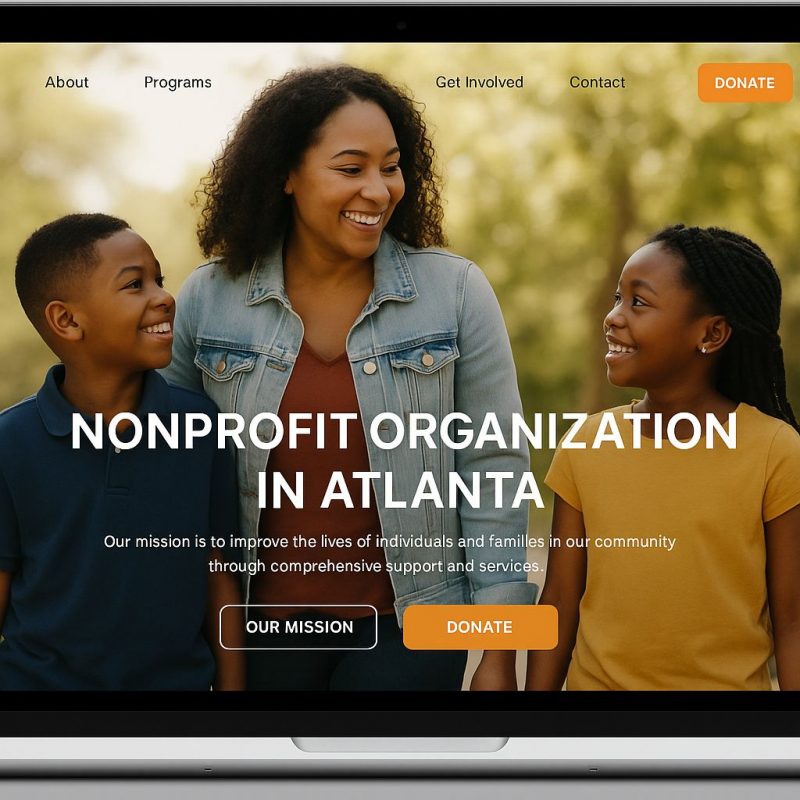
A donor clicks “Give Now” on an Atlanta nonprofit’s social media post. The donation page loads slowly on their phone. The form asks for a mailing address before showing gift amounts. The page looks nothing like the site they just came from. They close the tab. No error message. No crash. Just friction, and then silence.
That sequence plays out thousands of times a day across Metro Atlanta’s nonprofit sector, and most organizations never see it happen. There is no angry email, no support ticket, no complaint. The donor simply leaves, and the nonprofit counts a visit without understanding why it did not become a gift.
At Southern Digital Consulting, the evidence shows up in site audits. Donation buttons buried in submenus. Forms that require twelve fields before showing a gift amount. Mobile experiences that break at the moment of financial commitment. The patterns repeat across foundations in Midtown, grassroots organizations in Southwest Atlanta, and service nonprofits throughout the metro area.
The numbers tell the rest. Metro Atlanta has 46,000+ registered nonprofit organizations (Cause IQ). Only about 1% of nonprofit website visitors convert into donors or subscribers (Fundraise Up). But donation pages themselves average a 17% conversion rate (Virtuous, citing M+R Benchmarks). The gap between those two numbers is not a traffic problem. It is a site architecture problem. Visitors arrive. They just never reach the place where giving happens.
Where Atlanta Nonprofits Lose Donors Online (and the Numbers Behind It)
The M+R Benchmarks 2025 report found that donation page conversion rates averaged 11% on desktop and 8% on mobile (Blackbaud). Mobile giving continues to grow, but mobile donation completion consistently lags desktop. That spread matters in Atlanta, where the same donor researching your organization during a lunch break on Peachtree will attempt to give from their phone on MARTA that evening.
Atlanta’s donor landscape amplifies this problem. Corporate philanthropy runs deep here: Fortune 500 headquarters (Coca-Cola, Delta, UPS, Home Depot), corporate foundations with employee matching programs, and a culture of giving campaigns tied to workplace engagement. When a corporate employee at a Buckhead office searches for volunteer opportunities during their company’s annual giving week and lands on a nonprofit site that takes four taps to reach the signup form, the nonprofit does not get a complaint. It gets nothing. The employee moves to the next organization on the list.
The conversion gap between site visit and completed gift breaks down into identifiable failure points. Not one dramatic flaw, but a series of small ones that compound.
The Five Donation Funnel Leaks We Find in Atlanta Nonprofit Audits
These leaks repeat across every type of Atlanta nonprofit, from Midtown foundations running capital campaigns to grassroots organizations in Southwest Atlanta collecting $25 monthly gifts.
| Where Donors Leak | What We Find | What It Costs |
|---|---|---|
| Navigation to donation page | Donate button buried in submenu or footer; no contextual giving prompts in program pages | 99 out of 100 visitors leave a nonprofit site without donating or subscribing (Fundraise Up); every click between content and giving form reduces completion |
| Donation page load and branding | Form loads on a third-party page with different colors, fonts, and logo; donor feels redirected to an unfamiliar site | Trust breaks at the moment of financial commitment; abandonment rate climbs |
| Form complexity | Address fields, employer fields, phone number required before gift amount appears; no option to give without creating an account | Every additional required field reduces completion; best practice is three core steps: amount, frequency, payment |
| Mobile giving experience | Desktop-designed forms with small tap targets, horizontal scrolling, and no digital wallet integration (Apple Pay, Google Pay) | Mobile conversion runs 27% lower than desktop (M+R Benchmarks); Atlanta donors switching from desktop research to mobile giving hit friction at the worst moment |
| Recurring giving option | Monthly giving buried as a checkbox at the bottom of the form or absent entirely; no pre-selected recurring option | Recurring donors contribute more over their lifetime than single-gift supporters; nonprofits without a prominent recurring option leave long-term revenue on the table |
Each of these is a design and development decision made during the site build, not a fundraising strategy decision made afterward. When the funnel leaks, the fix is not a better email campaign. It is a better site.
The $10,000 Monthly Ad Budget Most Atlanta Nonprofits Never Touch
Google Ad Grants provides qualifying 501(c)(3) organizations with $10,000 per month in free Google Search advertising (Google for Nonprofits). That is $120,000 annually in donated ad credits. The program has distributed over $10 billion to more than 115,000 nonprofits worldwide since 2003.
The catch: the average Ad Grant account uses only $300 of the available $10,000 monthly budget (Getting Attention, citing industry data). Proper management requires 10 to 15 hours of expert work per month (Groas). Most Atlanta nonprofits either never apply, apply and underutilize, or lose the grant entirely due to compliance failures (minimum 5% click-through rate, keyword Quality Score of 3+, conversion tracking required).
The connection to your website is direct. Ad Grant campaigns drive search traffic to specific landing pages. If those pages are not built for conversion (clear mission statement, visible giving option, fast load, mobile-optimized forms), the traffic arrives and leaves without acting. The grant provides the fuel. The website determines whether that fuel produces anything.
This is the same dynamic that plays out across industries where publishing volume without structural depth fails to build authority. For nonprofits, the equivalent is driving Ad Grant traffic to pages that were never built to receive it. Picture a potential volunteer searching “food bank volunteer Atlanta” at 9 PM on a Tuesday. Your Ad Grant puts your site at the top. They click. They land on a homepage with no volunteer signup visible above the fold. They scroll, find nothing, leave. The grant spent the click. The site wasted it.
Any nonprofit considering the Ad Grant (or wondering why their current account underperforms) should start with the landing pages the grant would point to. If those pages are not conversion-ready, the grant will not fix what the site cannot deliver.
If your organization qualifies for the Google Ad Grant and has never activated it, or if your current account spends a fraction of the available budget, that is worth a conversation.
Why One-Time Donors Stay One-Time (and What Recurring Infrastructure Changes)
A first-time online donor is expensive to acquire. Email campaigns, social media advertising, Google Ad Grant traffic, event follow-up: all of that cost leads to a single gift. If the donor never returns, the acquisition cost exceeds the donation value for most small and mid-size nonprofits.
Recurring giving changes the math. But “add a monthly checkbox to the donation form” is not recurring infrastructure.
Recurring infrastructure starts with the form itself: the monthly option is pre-selected or prominently presented, not buried below a wall of fields. It extends into what happens after the gift. An automated welcome sequence arrives within the first hour. A tax receipt generates in January without the donor asking. Quarterly impact updates tie back to the donor’s giving level. A re-engagement sequence activates if giving lapses. Each of these runs in the background while the team is in the field doing the work that the website was built to fund.
For Atlanta nonprofits running corporate partnership campaigns (employee giving during United Way season, Giving Tuesday matching programs, year-end corporate philanthropy pushes), the infrastructure extends further. Dedicated corporate giving portals that show matching gift eligibility, volunteer hour tracking, and aggregate impact reporting give partnership managers a reason to recommend your organization over one whose website requires a phone call to process a company match.
Compliance also plays a role that most nonprofit leaders underestimate. Georgia requires charitable solicitation registration for organizations soliciting donations from state residents. 501(c)(3) status must be clearly disclosed on the website. Donor data must be handled according to privacy requirements.
A board member considering a five-figure gift will check your GuideStar/Candid profile, look for your Form 990, and scan for a Charity Navigator rating before writing the check. Financial transparency is not optional at that giving level. A site that buries or omits these signals loses trust with the donors who give the largest gifts.
The trust signals that satisfy donor due diligence are closely related to the E-E-A-T signals that search engines evaluate when determining whether a site deserves visibility. Transparency that earns donor trust also earns search engine trust. One investment, two returns.
What a Nonprofit Website Looks Like When Giving Is Part of the Architecture
Picture a corporate employee at a Buckhead office during their company’s annual giving week. They have thirty minutes between meetings. They search “volunteer opportunities Atlanta education.” They land on your program page, read two sentences about tutoring in Southwest Atlanta, and feel something. A giving prompt sits right there, inside the story, not in a separate navigation tab. They tap it. The form loads instantly, on-brand, with three pre-set monthly amounts. Apple Pay. Done. Fifteen seconds from impulse to completed recurring gift.
That is not a fantasy. It is what a site does when the giving architecture was planned alongside the content architecture. The donation prompt appears in context. The form matches the brand. A first-time donor and a returning monthly supporter see different experiences. The site handles a year-end traffic spike without the page that matters most failing under load.
None of this is incidental. It is the same layer of planning that determines whether a site ranks in local search, whether a form captures leads, whether a page retains attention. For nonprofits, the stakes are higher: every completed donation funds the mission, and every leaked donor is a missed connection between someone who wanted to help and an organization that needed them to.
At Southern Digital Consulting, we build nonprofit websites where giving is structural, not decorative. From donor funnel architecture to local search visibility that brings the right supporters to your site, we work with Atlanta nonprofits that are done losing donors to friction they cannot see.
Most nonprofit leaders know something is off with their website. Fewer know exactly where the donors leave or why the Ad Grant underperforms. That gap between instinct and diagnosis is where the money sits.
A free consultation closes that gap. No templates, no generic audits. Just a clear look at where your site loses the people it was built to reach.