
This article discusses search engine optimization strategy for cryptocurrency and Web3 projects. It is not investment, legal, tax, or compliance advice. Project teams and readers are advised to consult qualified professionals before acting on any specific recommendation.
Organic search is the primary scalable acquisition channel for blockchain projects, not by strategic preference but because paid advertising on Google, Meta, and X is restricted or banned for most crypto categories. A project can launch with a working protocol, a clean whitepaper, and a founding team that understands the technology, and still be invisible in organic search six months later. Google returns competitors, aggregator sites, and news articles about the category, but the project itself does not appear. The traffic that should be arriving through search is going to competitors who built their SEO foundations first.
This pattern is not unique to crypto. It is the same pattern we see across every industry where technically strong businesses neglect search visibility until competitors claim the positions. What makes crypto different is the speed at which it happens and the additional barriers blockchain projects face: restricted advertising channels, YMYL classification, volatile keyword demand, and technical architectures that search engines struggle to crawl. In plain terms: crypto projects cannot buy ads the way other businesses can, Google holds their content to stricter trust standards, the keywords they target can lose 90% of their search volume overnight, and their websites are often built in ways that search engines cannot read.
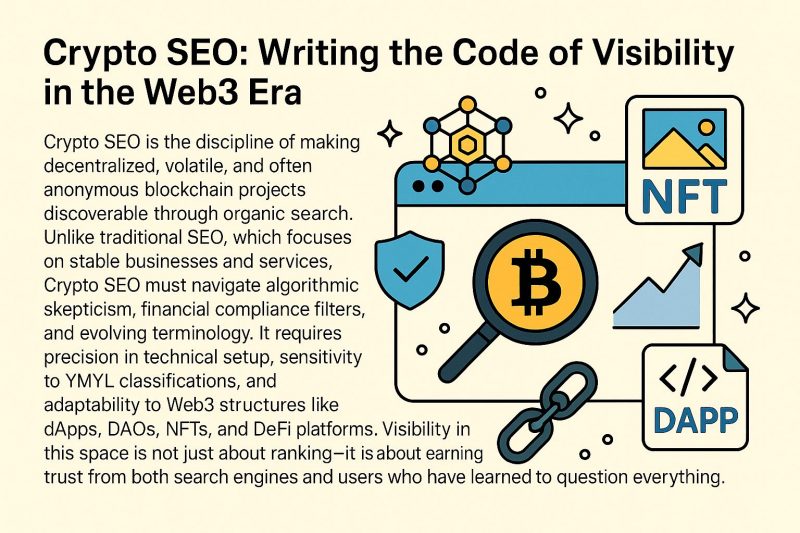
The foundational framing for Web3 SEO is covered in our earlier piece on crypto SEO and visibility in the Web3 era. This 2026 update layers three shifts onto that foundation: the AI citation channel, tightened YMYL standards, and the server-rendering architectures that have become table stakes.
Why Crypto SEO Operates Under Different Rules
The fundamentals of SEO apply to every industry: structured content, technical accessibility, authority signals, and content that matches search intent. Blockchain projects face constraints most businesses do not.
Advertising restrictions force organic dependence. Google Ads, Meta, and X restrict or ban advertising for DeFi protocols, unregistered tokens, and yield platforms. The paid campaigns that work for other industries are not available to most blockchain projects. Organic search becomes the primary scalable acquisition channel by default, not by choice.
YMYL classification raises the trust bar. Google classifies cryptocurrency content as Your Money or Your Life, applying elevated E-E-A-T standards. Content involving investment, asset transfer, or financial yield requires visible disclaimers, verified authorship, and transparent sourcing. Sites without clear terms, privacy policies, and editorial standards face demotion. Pseudonymous founding teams, a practice seen across portions of the Web3 ecosystem but far from universal, create additional friction because Google’s trust framework favors identifiable expertise.
Keyword demand fluctuates with market cycles. Search volume for trending tokens and categories can collapse by an order of magnitude between a bull run and a bear market, according to industry analysts tracking crypto SEO in 2025. Content strategies built around trending tokens become irrelevant within weeks. The projects that maintain search visibility balance trend-responsive content with evergreen technical resources that hold value regardless of market conditions.
Technical architectures resist crawling. Most dApps use JavaScript-heavy single-page applications where Googlebot sees an empty container instead of content. Web3.js alone exceeds 1MB uncompressed, which damages Core Web Vitals. Crypto sites face additional failure modes: LCP failures from charting libraries, CLS failures from price tickers without reserved space, and interaction delays from token table sorting blocking the main thread. Core Web Vitals pass rates for mobile sites remain under half the web in recent tracking, and crypto sites typically sit below that baseline without architectural intervention.
The Trust Problem That Defines Crypto Visibility
In most industries, a new business can build search authority gradually. In crypto, the trust deficit is structural. Users have been conditioned by scams, rug pulls, and failed projects to approach every new site with skepticism. Google’s algorithms reflect this same skepticism.
The E-E-A-T framework applies with particular force. Experience means demonstrating hands-on interaction with the protocols being discussed. Expertise means publishing authors with verifiable credentials, not anonymous handles. Authoritativeness means earning citations from recognized industry sources such as CoinDesk, CoinTelegraph, The Block, or Decrypt. Trustworthiness means visible disclaimers, transparent policies, and linked audit reports rather than badge graphics.
Industry commentary through 2026, including analysis from seoClarity and from crypto-marketing firms such as ICODA, points toward a consistent pattern: named authors with visible credentials perform better in both traditional and AI-driven discovery than anonymous contributors. For crypto projects where founding teams often operate pseudonymously, this creates a specific tension between Web3 cultural norms and search engine trust requirements. The projects navigating this successfully use ENS domains, linked GitHub commit histories, and verifiable conference appearances as alternative trust signals.
Smart contract audits serve a dual purpose. They reduce user risk, and they function as trust signals for search engines. An audit badge that links to the full report from a recognized firm such as Trail of Bits, CertiK, or OpenZeppelin carries more weight than a generic security icon. The same principle applies to any trust element: verifiable, not decorative.
At the site level, the trust infrastructure Google evaluates includes visible terms of service, privacy policies, clear contact or team information, and HTTPS with valid SSL. Sites lacking these basics are demoted automatically in YMYL categories. For crypto projects, the whitepaper represents an additional trust layer. Hosting it in HTML format, not only as a PDF download, enables indexing, anchor-based navigation, and schema integration. The HTML version can carry Article or TechArticle schema, author attribution, and Open Graph metadata, turning a static document into a discoverable search asset. Projects that publish whitepapers as downloadable PDFs without an indexed HTML version lose one of their strongest potential ranking pages.
The trust bar is higher in crypto than in almost any other vertical. The mechanisms for meeting it are the same ones that apply across every industry: make credentials visible, make claims verifiable, and make policies transparent. The execution is harder because Web3 culture resists some of these conventions. The projects that find the balance between cultural authenticity and search engine trust requirements are the ones building durable organic positions.
What Separates Crypto Sites That Rank From Those That Do Not
Research and industry tracking across 2025 and 2026 point to a consistent pattern in what drives AI and search engine citations: content depth, structured data, and editorial credibility outweigh traditional link-based authority signals.
Content depth outweighs backlink volume in current evaluation. In crypto, the projects earning consistent citations produce what industry analysts describe as “product journalism”: hands-on testing with disclosed methodology, original screenshots, and transaction data from actual protocol use. This is content that AI systems cannot generate because it requires someone to interact with the protocol directly. Generic explainers that restate whitepaper content without original analysis get buried. The winning format in 2026 is content that combines technical accuracy with original experience: gas fee analyses from real transactions, security comparisons tested across actual wallets, and protocol performance benchmarks conducted with disclosed parameters.
Structured data enables AI citation. FAQ schema, Article schema, and SoftwareApplication schema help search engines and AI systems identify what a crypto page covers. Industry tracking in late 2025 and early 2026 suggests that commercial intent prompts trigger web search in AI systems at substantially higher rates than informational queries. Because most crypto content skews informational, the content type with the lowest AI search trigger rate is the one crypto projects produce most heavily. Structured data helps close the gap by making informational content machine-readable enough to earn citations when searches do occur. For token pages specifically, FinancialProduct schema with attributes for supply breakdown, audit status, and blockchain compatibility creates the machine-readable layer that both traditional search and AI systems use to evaluate relevance. The mechanics of AI-driven search and citation are covered in reprogramming SEO: how AI tools, agents, and overviews are shaping the future of search.
Hybrid rendering solves the crawlability gap. The dominant solution for dApp architecture in 2026 is server-side rendering of SEO-critical content (protocol description, team, tokenomics) while keeping wallet-connection functionality client-side. This ensures search bots see complete content while users retain the interactive experience. Projects using client-side rendering alone create pages that appear blank during Googlebot crawls. The fix is architectural, not cosmetic: Next.js or similar frameworks with server-side generation for content pages, client-side only for wallet interactions.
Topical clustering compounds authority. A page about a DeFi protocol gains more authority when surrounded by related content: explainers for the underlying blockchain, comparison guides against competing protocols, and technical analyses of governance mechanisms. The most effective crypto content architectures group pages by protocol ecosystem or use case rather than by keyword similarity, creating semantic relationships that search engines recognize as topical authority. This principle parallels the zero-click modeling framework for YMYL finance content discussed in how to model zero-click finance SEO behavior without search data.
Off-page authority requires industry-specific sources. A backlink from CoinDesk or The Block carries more weight for a crypto project than a link from a generic business directory. Organic link development in Web3 occurs through community ecosystems: DAO forums, developer documentation contributions, governance participation, and research publications. Paid placements in crypto media are common and are evaluated for nofollow status before being pursued as authority signals. The strongest off-page signal in 2026 is editorial citation from recognized industry sources, earned through content quality rather than outreach volume.
Where the Channel Is Heading
Two forces are reshaping crypto search visibility simultaneously.
AI-generated answers now appear across Google AI Overviews, ChatGPT, and Perplexity. For crypto, AI Overviews trigger most frequently on informational queries such as “what is [concept]” or “how does [protocol] work,” precisely the queries most crypto content strategies target. Research from Seer Interactive (September 2025, analyzing 3,119 queries across 42 organizations) found that brands cited in AI Overviews earned approximately 35% more organic clicks than those not cited, a finding corroborated by Pew Research Center behavioral data showing click rates dropping from 15% to 8% when AI Overviews appear. Projects optimizing for AI citation, not only for traditional ranking, position themselves to capture both channels. The broader implications of this shift are developed in the AI revolution transforming SEO strategies for 2025 and beyond and in our AI SEO services overview.
Google is also converting previously organic-only result types into advertising inventory across verticals. For crypto projects that cannot advertise, this makes organic positioning both more valuable and more contested.
The projects best positioned to hold search visibility through this transition share common characteristics: server-rendered architectures that search engines can crawl, named authors with verifiable credentials, content built from original protocol interaction rather than restated documentation, and structured data that makes every page legible to AI citation systems.
The Framework That Applies Regardless of Industry
The SEO discipline Southern Digital Consulting applies to local service businesses, professional firms, and content-driven sites transfers directly to crypto and Web3 with adjusted execution. The audit starts the same way: what does the site look like to a search engine, what does it look like to a user, and where is the gap between the two?
For blockchain projects, that gap is typically wider than in traditional industries. The technical barriers are higher, the trust requirements are stricter, and the competitive timeline is compressed. The framework is identical: make the site crawlable, make the content trustworthy, match the content to search intent, and measure whether the investment produces return.
If your Web3 project has a working product and limited organic visibility, the problem is almost always structural. Southern Digital Consulting maps that visibility gap across structure, content, and timeline. Start with a free consultation.
About the Author Reviewed by Nick Rizkalla, Co-Founder of Southern Digital Consulting. SDC brings over 25 years of SEO and digital marketing experience to businesses ranging from local service providers in Georgia to national brands navigating AI search, YMYL compliance, and technical visibility challenges across emerging verticals.